
Beyond Indictment
History, Conscience, and the Unfinished Struggle for Myanmar's Freedom

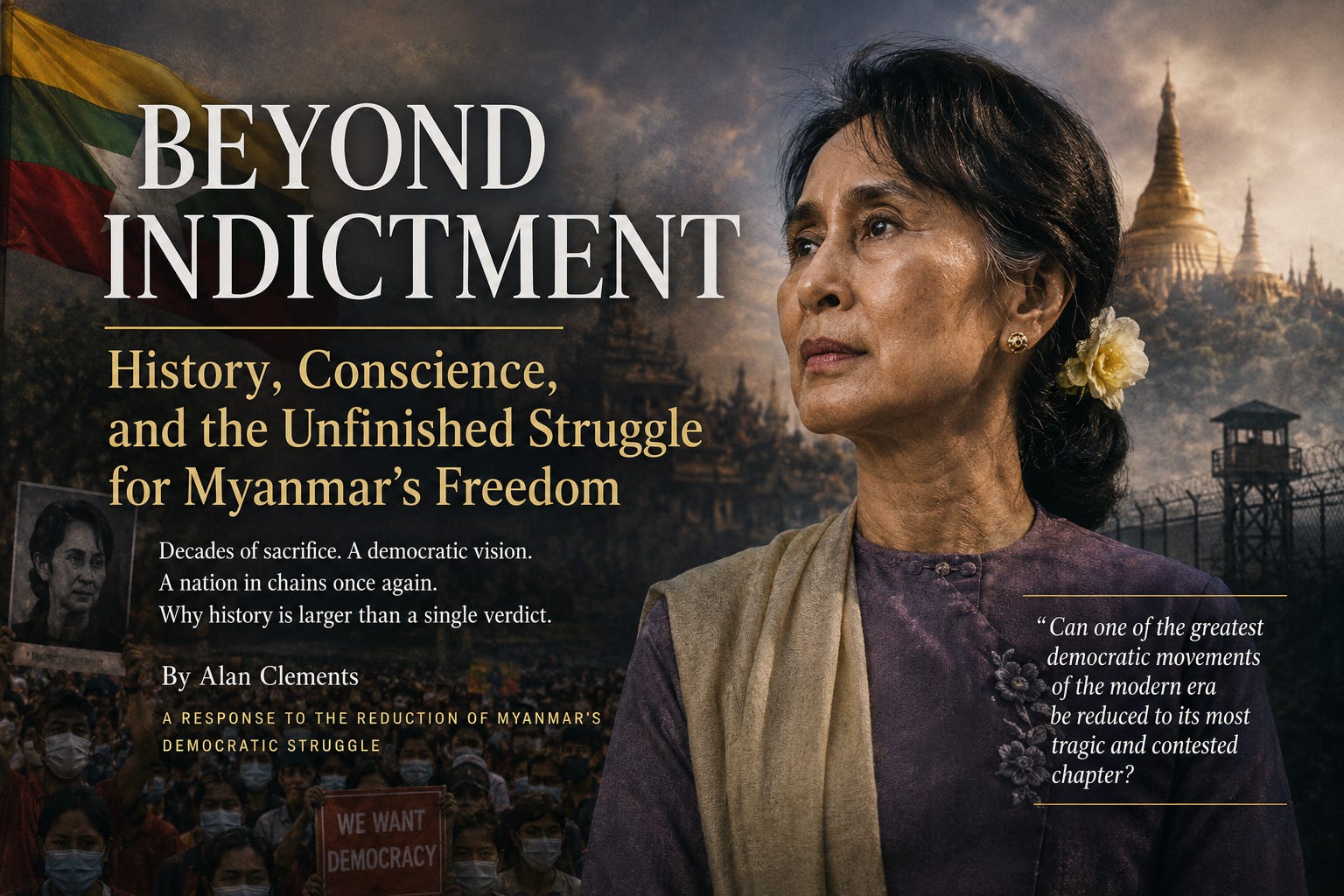
By Alan Clements
My recent open appeal to United Nations Special Envoy Julie Bishop was animated by a simple humanitarian principle: no prisoner should disappear into the darkness of state secrecy. Whatever political disagreements one may have with Aung San Suu Kyi, whatever criticisms may be leveled at her decisions in office, and whatever conclusions history may ultimately draw about her legacy, there remains a fundamental obligation to demand proof that she is alive, medically cared for, and not being subjected to the enforced disappearance that Myanmar’s military regime has inflicted upon countless others. The right to humane treatment does not depend upon political popularity. It does not depend upon ideological conformity. It does not depend upon whether a person is celebrated, controversial, admired, or condemned. It is a principle that either applies to all human beings or it means very little.
What struck me in the response to that appeal was not disagreement over the humanitarian request itself. Rather, it was the familiar insistence that any discussion of Aung San Suu Kyi must first pass through a predetermined moral tribunal. Before one may acknowledge her sacrifices, one must recite her failures. Before one may recognize her historical significance, one must accept a particular interpretation of her role in the Rohingya crisis. Before one may express concern for her imprisonment, one must agree that her place in history has already been settled.
This approach reflects a larger problem in the way Myanmar is increasingly discussed. One of the most remarkable democratic movements of the modern era is being reduced to a single chapter, a single controversy, and ultimately a single verdict. The extraordinary complexity of Myanmar’s struggle against military dictatorship—its decades of sacrifice, courage, compromise, tragedy, and aspiration—is increasingly compressed into a prosecutorial narrative centered almost exclusively upon one issue and one individual.
The question is not whether difficult questions should be asked. They should. The question is whether history itself is being served when the entirety of a democratic struggle is interpreted through a framework so narrow that it obscures more than it reveals.
To understand why this matters, one must begin not in 2017, nor in Rakhine State, but decades earlier in a country subjected to one of the world’s most enduring systems of military domination. For generations, Myanmar’s armed forces governed through fear. Political opponents were imprisoned. Journalists were censored. Students were beaten, arrested, and killed. Ethnic communities endured repeated military campaigns. Torture, surveillance, intimidation, and arbitrary detention became familiar features of daily life. An entire population learned that the simple act of speaking honestly could carry devastating consequences.
Against this machinery of repression emerged a democratic movement whose achievements are too often forgotten amid contemporary debates. Monks marched unarmed into confrontation with soldiers. Students organized despite the certainty of arrest. Writers continued to speak despite censorship. Ordinary citizens repeatedly risked their freedom and, in many cases, their lives in pursuit of a future they might never personally enjoy. The struggle for democracy in Myanmar was never merely a political project. It was a profound moral undertaking sustained by extraordinary courage.
Aung San Suu Kyi became the most recognizable figure within this movement not because she possessed military power or controlled state institutions, but because millions of people came to see in her a rare convergence of personal sacrifice, political discipline, and moral conviction. Her years of house arrest were real. Her decision to remain in Myanmar while her husband was dying abroad was real. Her willingness to surrender personal freedom in service of a democratic vision was real. These experiences transformed her into a symbol not only for Myanmar but for people around the world who believed that nonviolent resistance could confront even the most entrenched forms of authoritarian power.
None of this means that she should be immune from criticism. It does mean, however, that criticism should be proportionate to historical reality. One of the most common errors in the interpretation of public figures is the temptation to allow a single chapter of a life to eclipse everything that came before it. Human beings are more complicated than that. Political movements are more complicated than that. History itself is more complicated than that.
The Rohingya crisis represents one of the most painful and tragic chapters in Myanmar’s modern history. The suffering endured by Rohingya communities cannot be honestly denied or minimized. The destruction of villages, the displacement of hundreds of thousands of people, the trauma carried by families forced across borders, and the continuing uncertainty facing an entire population demand recognition, compassion, and serious reflection. Any discussion that fails to acknowledge these realities begins from a position of moral deficiency.
Yet acknowledging suffering does not require abandoning complexity. Indeed, genuine moral seriousness demands the opposite. It requires a willingness to confront difficult facts even when they complicate preferred narratives.
One of the striking features of many contemporary discussions of the Rohingya crisis is the tendency to begin the chronology only after violence had already erupted. Missing from many accounts is meaningful consideration of the role played by the Arakan Rohingya Salvation Army, or ARSA, an armed insurgent organization designated as a terrorist group by Myanmar authorities following coordinated attacks on police and military outposts in northern Rakhine State. In October 2016 and again in August 2017, ARSA launched simultaneous assaults against security installations, resulting in deaths among security personnel and contributing to an atmosphere of escalating instability in an already volatile region.
To acknowledge these attacks is not to justify atrocities. It is not to excuse abuses. It is not to diminish the suffering of civilians. Rather, it is to insist upon a principle essential to any honest historical inquiry: chronology matters. History did not begin with the military response. Nor did it begin when international headlines first appeared. Events unfolded within a context shaped by insurgency, communal tensions, competing nationalisms, decades of mistrust, military domination, and rapidly deteriorating security conditions. Any account that excludes these realities risks replacing history with advocacy.
For many people inside Myanmar, the ARSA attacks were perceived as a serious security crisis. Whether outside observers agreed with that perception is not the point. The perception existed, and it influenced public opinion, political discourse, and the broader environment within which decisions were made. History becomes distorted when chronology is selectively edited to support conclusions already reached in advance.
Equally troubling is the assumption that Myanmar’s civilian leadership possessed powers, information, and freedom of action that it did not actually possess. Much contemporary commentary proceeds as though the civilian government and military establishment functioned as willing partners in a coherent political project. Such interpretations bear little resemblance to the realities of Myanmar’s constitutional structure or political history.
The military that imprisoned Aung San Suu Kyi following the coup of 2021 was the same military that had imprisoned her for years. It was the same military that had repeatedly targeted democracy activists, suppressed dissent, censored journalists, and sought to weaken the movement she represented. The relationship between Myanmar’s democratic forces and the military was not one of harmony or collaboration. It was defined by decades of hostility, mistrust, and structural conflict.
Myanmar’s democratic transition was never a transition in the conventional sense. It was a fragile political experiment conducted within a constitutional framework deliberately designed to preserve military influence. The armed forces retained control over key ministries, controlled the security apparatus, maintained extensive economic interests, and remained, in many respects, a state within a state. This reality does not erase questions of accountability, nor does it absolve civilian leaders of responsibility for decisions made during their time in office. It does, however, complicate simplistic narratives that imagine civilian authorities exercising unrestricted power over institutions they did not control.
The same tendency toward simplification appears in discussions of Aung San Suu Kyi’s appearance before the International Court of Justice in The Hague. For some observers, this event functions as the definitive moral verdict upon her life. The argument is straightforward: she appeared before the court, defended Myanmar’s position, and therefore her historical legacy is permanently settled.
Such certainty may be emotionally satisfying, but history rarely rewards certainty.
Many people within Myanmar understood her appearance at The Hague differently. They saw a national leader attempting to defend her country from complete international isolation while preserving an already fragile democratic opening. They saw a politician navigating tensions between domestic realities and international expectations under circumstances that offered no easy choices. They saw the daughter of Aung San, the founder of modern Myanmar and the architect of the country’s military, attempting to hold together a nation whose democratic transition remained deeply precarious.
One may disagree with her judgment. One may conclude that she made serious mistakes. One may believe she should have acted differently. These are legitimate positions within a democratic conversation. What is not legitimate is the assumption that disagreement automatically resolves every historical question. The Hague remains a subject of debate precisely because reasonable people continue to interpret its meaning differently.
Lost amid these arguments is a deeper truth about Aung San Suu Kyi’s political vision. Her life’s work was never based upon the destruction of the military. It was based upon the belief that Myanmar’s future required transformation rather than annihilation, dialogue rather than permanent warfare, and reconciliation rather than vengeance. Whether one believes this vision was realistic is open to debate. What cannot honestly be denied is that it represented the philosophical foundation of her political project from the beginning.
This commitment to reconciliation is often misunderstood by observers who view politics primarily through the lens of power. Yet the democratic movement in Myanmar was never simply a struggle to replace one ruling class with another. At its best, it represented an attempt to create a political culture capable of transcending the cycles of violence that had scarred the nation for generations. That aspiration may have been imperfectly realized. It may even have failed. But failure does not erase the significance of the aspiration itself.
What is particularly striking in contemporary discussions is how little attention is devoted to what followed the collapse of Myanmar’s democratic experiment. The military seized power. Thousands were killed. Millions were displaced. Entire communities were devastated. Democracy itself was decapitated. The very institution that democratic reformers spent decades attempting to transform revealed once again its enduring contempt for civilian rule.
Yet even after witnessing this catastrophe, some commentators remain determined to devote their greatest energies not to understanding the destruction of democracy, but to reducing the democratic movement itself to its imperfections.
This raises a larger question. Can one of the most consequential democratic movements of the modern era be understood primarily through its most tragic and contested chapter? Can decades of sacrifice, imprisonment, resistance, and aspiration be compressed into a single moral verdict? Can a life devoted to confronting dictatorship be reduced to one interpretation of one period of governance under extraordinarily constrained circumstances?
These questions matter because they concern more than Aung San Suu Kyi. They concern how history remembers struggles for freedom. They concern whether complexity is permitted to survive ideological polarization. They concern whether future generations will encounter the story of Myanmar’s democratic movement in its full human richness or merely as a simplified morality play.
History’s most consequential figures are rarely saints. They are rarely villains. More often, they are human beings attempting to navigate circumstances larger than themselves while carrying burdens that later observers can only partially understand. Aung San Suu Kyi belongs to this category. Her story is neither one of perfection nor one of moral collapse. It is the story of a woman who inspired millions to believe in democratic possibility, who confronted one of the world’s most entrenched dictatorships, who sought reconciliation in a deeply divided nation, and who became entangled in one of the most painful and contested chapters of her country’s history.
To reduce such a life to a single accusation is not an act of moral clarity. It is an act of historical impoverishment. And it is precisely because the suffering of the Rohingya was real, because the brutality of military rule remains real, and because the struggle for Myanmar’s freedom remains unfinished, that we owe ourselves something more demanding than simplification. We owe ourselves the discipline of complexity, the humility to acknowledge uncertainty where uncertainty exists, and the wisdom to recognize that history is not served by reducing human lives to indictments. It is served by the far more difficult task of understanding them in full.
About the Author
Alan Clements is an author, former Buddhist monk ordained in Burma, and longtime human-rights advocate whose life’s work has centered on conscience, nonviolence, and the struggle against authoritarian rule. He is the author of seventeen books, including Conversation with a Dictator, Unsilenced: Aung San Suu Kyi—Conversations from a Myanmar Prison, and Politics of the Heart: Nonviolence in an Age of Atrocity. For more than three decades he has worked closely with Burmese democracy leaders, former political prisoners, monks, and civil-society voices. His essays and interviews have appeared in international media across Asia, Europe, and the United States.