
Beyond Rebirth: Navigating Existence Toward the Freedom of Nibbāna

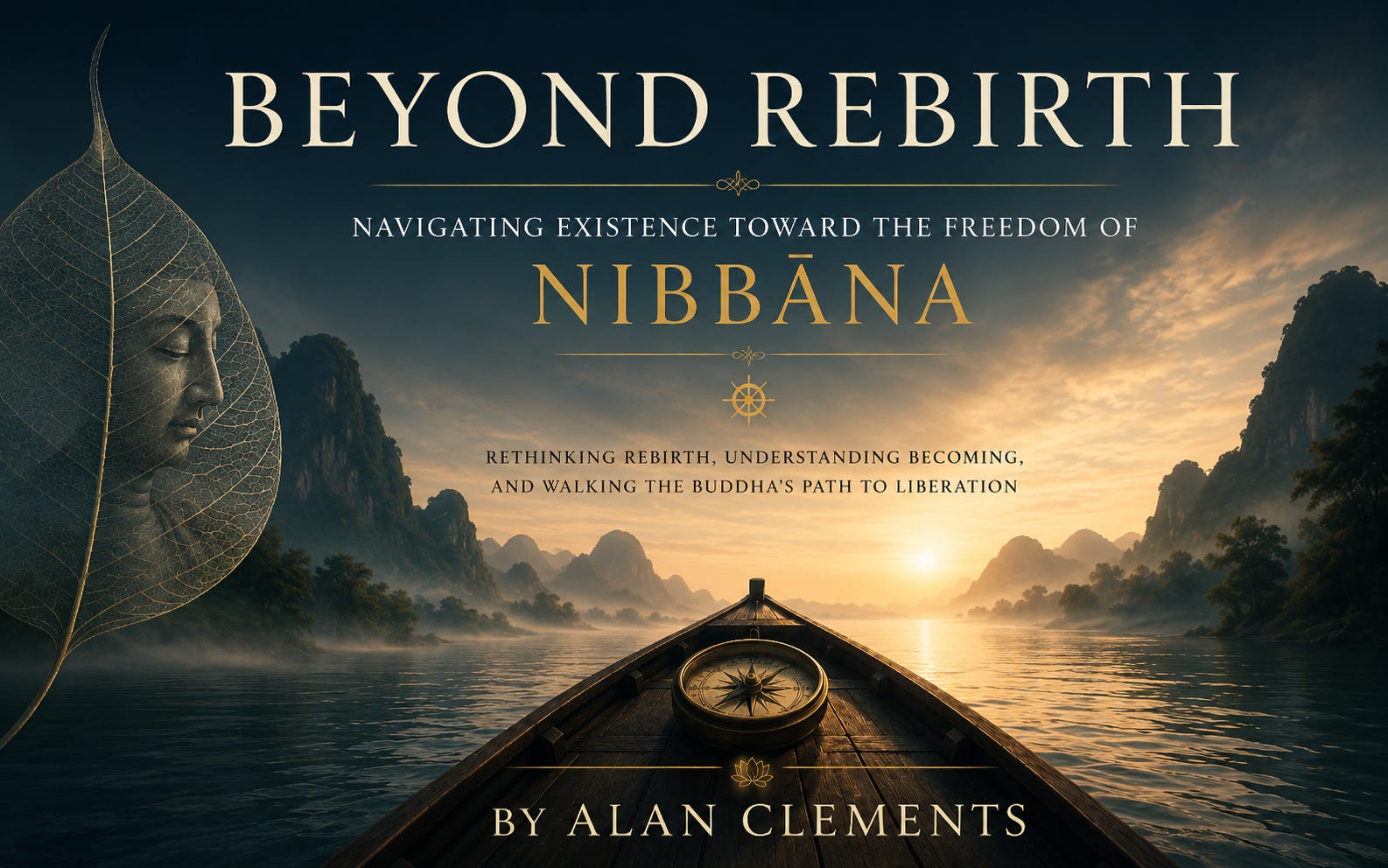
By Alan Clements
Perhaps no word in Buddhism has generated more misunderstanding than rebirth. The English term arrives already burdened with metaphysical assumptions inherited from other religious traditions. It evokes the image of an enduring self-surviving bodily death, carrying its identity, memories, desires, unfinished stories, rewards, and punishments from one lifetime into another across an endless pilgrimage through time. Whether embraced as an article of faith or dismissed as religious mythology, the discussion almost invariably begins with the same question:
“What happens to me after I die?”
The Buddha, however, appears to have been asking a far more radical question—one capable of overturning the very assumptions upon which that inquiry rests.
What if the problem is not what happens to “me” after death, but the unquestioned conviction that there exists, in the deepest sense, a permanent “me” to begin with? What if the Dharma is concerned less with the migration of identity through successive lives than with the continuous arising of existence itself? What if the Buddha’s supreme discovery was not a cosmology explaining reincarnation but a phenomenology revealing the architecture of becoming?
This subtle shift in perspective changes nearly everything.
The heart of Buddhist psychology is not primarily a theory of cosmic continuity but an investigation into conditionality itself. Again and again, throughout the earliest discourses, the Buddha returns to one of the most elegant formulations in the history of philosophy:
“With this as condition, that arises; with the cessation of this, that ceases.”
The emphasis is never placed upon an enduring entity journeying through time. It rests instead upon relationships, conditions, processes, and emergence. Reality is revealed not as a collection of permanent things but as an immeasurably subtle ecology of dynamic events, each moment conditioning the next in an uninterrupted unfolding of dependent relationships. Existence is not fundamentally a world of nouns but of verbs—not fixed beings but continuous becoming.
This insight invites us to reconsider what has traditionally been translated as rebirth.
Perhaps the central question is not whether someone returns after death. Perhaps the deeper inquiry concerns how existence is continuously giving birth to itself, moment after moment, through the inexhaustible interplay of causes and conditions.
Birth, from this perspective, is no longer merely a biological event occurring once between conception and infancy. It is the perpetual emergence of experience itself. Every act of grasping gives birth to another moment of grasping. Every fear conditions another landscape of fear. Every gesture of generosity opens new possibilities for generosity. Every illusion silently constructs the architecture within which future suffering may arise. Every moment of wisdom, likewise, gives birth to a world in which greater freedom becomes possible.
Existence, in this sense, is forever being born.
The Twelvefold Chain of Dependent Origination (paṭicca samuppāda) is therefore far more than a chronology extending across successive lifetimes. It is, more fundamentally, a phenomenology of becoming—a meticulous examination of the manner in which existence continually gives rise to itself through an immeasurably intricate web of causes and conditions. Ignorance conditions volitional formations. Formations condition consciousness. Consciousness conditions name-and-form. Name-and-form conditions the six sense bases, from which feeling, craving, clinging, becoming, birth, and ultimately aging and death emerge. At every stage, the emphasis rests not upon an enduring identity passing through the sequence but upon the ceaseless unfolding of conditioned processes. The entire structure invites us to look away from the search for permanence and toward the living dynamics of emergence itself.
What appears to us as continuity is, upon closer examination, an extraordinarily rapid succession of conditioned events, each arising because innumerable causes converge and each dissolving as those conditions disperse. Consciousness is not a fixed substance moving through time but an ever-changing stream whose apparent stability is created by the astonishing speed with which experience continually reconstructs itself. The sense of a permanent self emerges not because such a self can ultimately be found, but because the mind instinctively weaves these fleeting moments into the compelling narrative of an enduring “I.” What appears solid is revealed, through sustained contemplative inquiry, to be remarkably fluid.
This vision carries profound philosophical consequences because it enables the Buddha to avoid the two metaphysical extremes that have shaped so much of humanity’s religious and philosophical imagination. On the one hand, he rejects eternalism, for nowhere within careful observation of body, feeling, perception, mental formations, or consciousness does an independent, permanent self-reveal itself. Yet he rejects annihilationism with equal force, because the absence of an enduring self does not imply the collapse of causality. Causes continue to generate consequences. Intentions continue to shape experience. Conditionality remains fully operative even when the fiction of an autonomous owner has dissolved. Continuity survives without requiring identity, and causality persists without demanding an immortal soul to carry it forward.
The familiar image of the seed offers one of the clearest ways of understanding this subtle insight. A seed becomes a tree, and the tree eventually bears another seed. We would not ordinarily say that the original seed has reincarnated, nor would we conclude that the second seed bears no relationship whatsoever to the first. Both assertions fail to capture what has actually occurred. The relationship between them is neither one of absolute identity nor complete separation. It is a relationship of conditional emergence. The second seed exists because innumerable conditions allowed the first to unfold into the living process we call a tree. Nothing permanent has migrated from one form into another, yet nothing has arisen independently. The continuity belongs not to an enduring essence but to the lawful unfolding of conditions themselves.
Seen in this light, the image of the seed becomes more than a botanical metaphor; it becomes a profound illustration of existence itself. Every phenomenon participates in an immeasurable network of relationships extending far beyond anything that can meaningfully be called “self.” Soil, rainfall, sunlight, climate, microorganisms, gravity, time, and countless unseen forces all participate in bringing forth what appears before us as a single tree. Human existence unfolds no differently. What we call a person is not an isolated entity but a living convergence of biological, psychological, social, historical, ethical, and environmental conditions, all arising together in continuous reciprocity. We exist less as independent beings than as dynamic expressions of an infinitely interconnected universe.
This understanding transforms the emphasis of Buddhist practice in a profoundly liberating way. The Dharma ceases to be primarily a matter of speculation about future lives and becomes, instead, an inquiry into present becoming. The central question is no longer whether one will be reborn after death, but rather what one is continually bringing into existence through the quality of one’s present awareness. What forms of consciousness are being cultivated? What habits of perception are being strengthened? What conditions are quietly taking root through every intention, every word, every action, and every movement of attention? The future, from this perspective, is not simply something awaiting us beyond the horizon of time; it is something being continuously shaped by the innumerable conditions we are creating in this very moment.
It is here that I find the language of navigation considerably more illuminating than the language of rebirth. The metaphor of navigation shifts our attention away from metaphysical certainty and toward lived participation. It invites responsibility rather than belief, discernment rather than speculation. Above all, it captures something essential about the Buddha’s project. He was not, in my understanding, constructing a theology of invisible worlds so much as offering a practical cartography of existence itself. His concern lay not with describing the geography of heaven or the mechanics of an afterlife, but with revealing the subtle currents through which consciousness repeatedly becomes entangled in craving, fear, attachment, identification, and suffering. His teaching resembles less a system of religious doctrine than an exquisitely refined phenomenological map of the human condition, identifying the hidden currents, invisible undertows, and recurring patterns through which becoming continually generates yet more becoming. The Dharma thus becomes the art of navigation: the gradual cultivation of sufficient wisdom, mindfulness, and compassion to move through existence with increasing lucidity until the very mechanisms generating unnecessary suffering are understood so completely that they finally lose the power to determine the course of consciousness.
From this perspective, Nibbāna is not another destination within the cycle of becoming, nor the highest realm awaiting consciousness beyond death. It is not an eternal location inhabited by an enlightened self, nor the culmination of an endless spiritual journey through successive worlds. Such interpretations subtly preserve the very assumptions the Buddha devoted his teaching to dismantling. Nibbāna is better understood as the cessation of compulsive becoming itself—the ending of that interior momentum through which consciousness repeatedly fabricates identity, appropriates experience as “I” and “mine,” and continually generates worlds organized around craving, aversion, and ignorance.
Freedom, therefore, is not realized because someone escapes existence. It appears because the compulsive necessity to organize existence around a fictional center has finally come to rest. What ceases is not life itself, but the endless psychological machinery that repeatedly converts the fluidity of experience into the burden of selfhood. The Dharma points not toward the destruction of the person but toward liberation from the illusion that there has ever been an independently existing person to defend, possess, or perpetuate.
This understanding also transforms the meaning of ethics. Karma no longer appears primarily as an invisible accounting system distributing rewards and punishments across future lifetimes. Instead, it reveals something far more immediate and, perhaps, more profound. Every thought, every word, every intention, and every action participates in shaping the very texture of existence itself. We are never merely observers inhabiting a finished universe. We are active participants in an immeasurable web of conditional relationships through which reality is continuously being created. Every moment of consciousness contributes, however subtly, to the architecture of the world that follows.
The practical question of Buddhism therefore becomes breathtakingly immediate. It is no longer, “Where will I go when I die?” It becomes, instead, “What am I giving birth to now?” Every moment of mindfulness interrupts one stream of becoming while nourishing another. Every relinquishment of greed alters the conditions through which future experience will arise. Every act of generosity expands the horizon of what becomes possible. Every genuine expression of compassion reorganizes, however quietly, the field of relationships from which tomorrow’s consciousness will emerge. The Dharma continually returns us to the extraordinary recognition that the future is never simply awaited; it is being conditioned through the quality of our present participation.
Seen in this light, the Buddha’s teaching is neither optimistic nor pessimistic. It is profoundly liberating because it restores responsibility precisely where metaphysical speculation so often removes it. Rather than inviting fascination with inaccessible past lives or imagined future births, it directs our attention toward the only place transformation has ever been possible: this unfolding moment of conditioned existence. Liberation ceases to be an abstract promise deferred until another lifetime and becomes an ever-present possibility arising whenever wisdom interrupts the unconscious momentum of becoming.
Perhaps this is why Nibbāna has always seemed less like an answer than a direction. It is the horizon toward which the entire Dharma quietly points—not another birth, not another identity, not another metaphysical achievement, but the gradual exhaustion of everything that makes endless becoming appear necessary. It is not acquired as one acquires knowledge or status. It reveals itself as craving loses its authority, as clinging relinquishes its grip, and as consciousness gradually discovers the freedom inherent in no longer needing to become someone else.
The Buddha was not inviting humanity to believe in another world. He was inviting us to understand this one so completely that the restless impulse to escape it, transcend it, possess it, or perpetually recreate it finally comes to rest. His teaching is radical precisely because it redirects our attention away from metaphysical speculation and toward the living dynamics of experience itself. What requires liberation is not the universe but our relationship to it.
Perhaps this, finally, is the deepest meaning of Nibbāna. It is not escape from existence but complete intimacy with existence, lived without appropriation, without resistance, and without the compulsive need to transform experience into an enduring self. It is the flowering of a wisdom so complete that the tides of craving no longer determine the direction of consciousness. What remains is not emptiness in the impoverished sense of absence, but freedom in its fullest sense: luminous, unconditioned, immeasurably peaceful, and beyond the endless necessity of becoming.
About the Author
Alan Clements is an author, former Buddhist monk ordained in Burma (Myanmar), investigative journalist, and longtime human-rights advocate whose life’s work has explored the meeting place of contemplative inquiry, existential freedom, democracy, aesthetics, and conscience. Having trained intensively under several of the twentieth century’s foremost Theravāda meditation masters, including Mahāsi Sayadaw and Sayadaw U Pandita, he has devoted more than four decades to examining the Buddha’s teachings through the complementary lenses of phenomenology, psychology, ethics, and lived experience rather than through the framework of religious dogma alone.
The author of seventeen books, Clements writes at the intersection of Buddhist philosophy, political freedom, dialogue, human dignity, and the evolution of consciousness. His work seeks to recover the Dharma not as a system of beliefs requiring acceptance, but as a rigorous investigation into the conditions that give rise to suffering, wisdom, compassion, beauty, and liberation. Drawing equally upon contemplative practice, philosophical inquiry, and decades of engagement with Myanmar’s democracy movement, his essays invite readers to encounter the Buddha’s teachings as a living exploration of existence itself. Central to his work is the conviction that awakening is neither an escape from the world nor a retreat into private spirituality, but the cultivation of a freedom capable of transforming both the individual heart and the shared life of humanity.