
When Silence Becomes Complicity: An Open Letter to the International Committee of the Red Cross About Aung San Suu Kyi
Confidentiality, Conscience, and the Moral Responsibilities of Humanitarian Witness in an Age of Authoritarian Secrecy

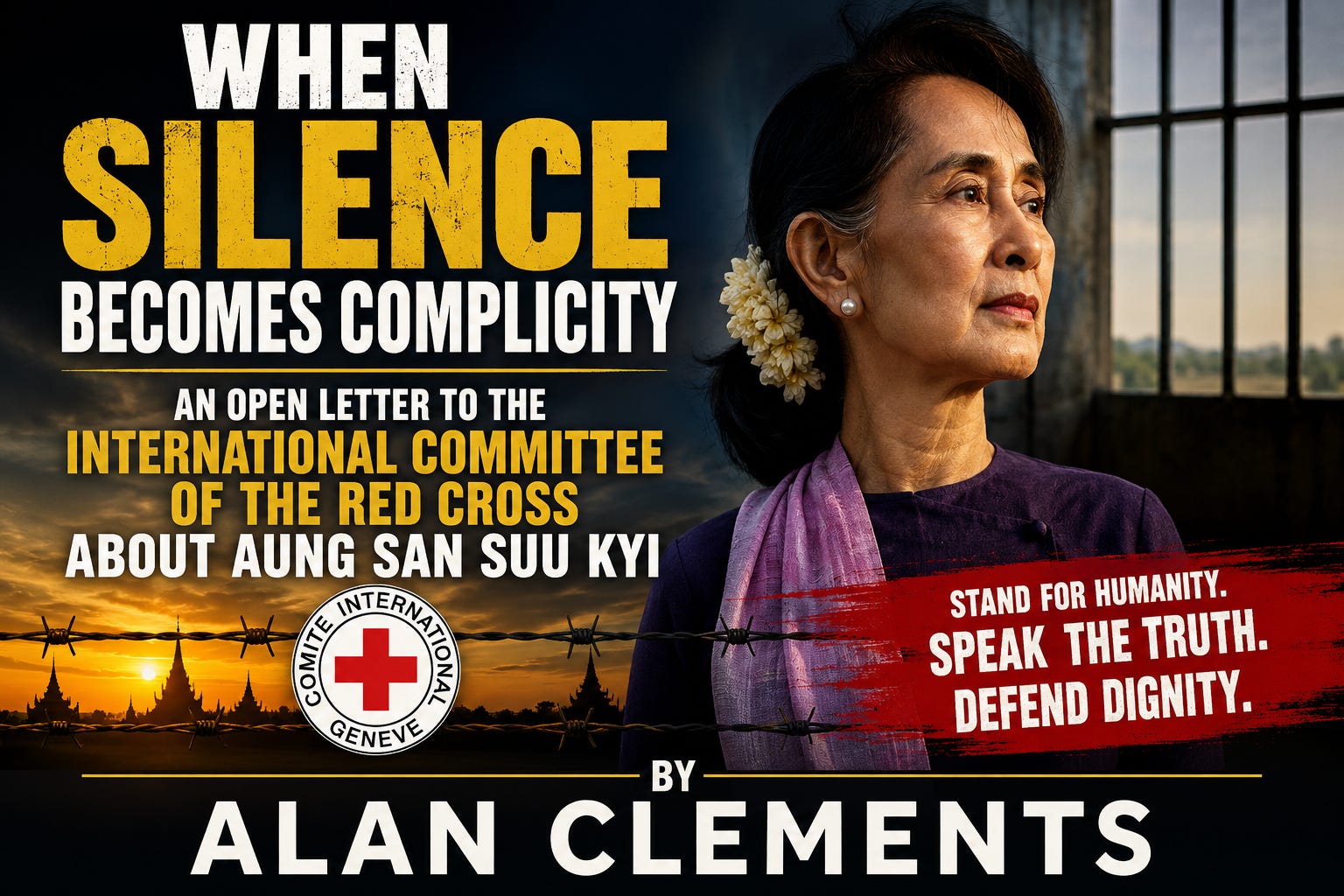
READ on MIZZIMA MYANMAR NEWS When Silence Becomes Complicity: An Open Letter to the International Committee of the Red Cross About Aung San Suu Kyi
There are moments in history when silence is an act of wisdom. There are other moments when silence itself becomes the subject demanding examination. The distinction is not merely rhetorical. It reaches into the heart of moral philosophy, humanitarian practice, and the responsibilities borne by institutions whose authority rests upon public trust. Every enduring principle, however noble, eventually encounters circumstances that compel us to ask not whether the principle remains valid, but whether its application continues to serve the humanity from which it first drew its meaning.
For more than a century and a half, the International Committee of the Red Cross has earned one of the world’s most respected humanitarian reputations by practicing disciplined confidentiality. Governments at war, military dictatorships, insurgent movements, and authoritarian regimes have repeatedly granted the organization access to prisoners and conflict zones precisely because they understood that humanitarian visits would not be transformed into political theater. This quiet diplomacy has saved innumerable lives. It has reunited families separated by war, brought medicine where governments refused compassion, and opened prison doors that otherwise would have remained forever sealed. Few institutions have done more, often without recognition and deliberately outside the glare of publicity, to preserve human dignity amid humanity’s darkest hours. That legacy deserves profound admiration.
Yet history teaches another lesson no less important. Every institution eventually encounters moments when fidelity to its own traditions requires renewed examination of how those traditions are exercised. Principles exist to serve humanity. Humanity does not exist to serve principles. Confidentiality is not an end in itself. It is a means by which suffering may be alleviated. When circumstances change so dramatically that silence itself risks becoming part of the architecture of oppression, the moral question is no longer whether confidentiality remains valuable. The question becomes whether confidentiality alone adequately fulfills the humanitarian mission it was created to protect.
No contemporary case presents this dilemma more starkly than that of Daw Aung San Suu Kyi.
For years, one of the world’s most recognizable prisoners of conscience has existed in a condition approaching enforced disappearance. The Nobel Peace Prize laureate who once stood before immense crowds as the democratic conscience of Myanmar has effectively vanished behind the walls of a military prison. The international community knows astonishingly little about her physical condition, her psychological well-being, the quality of medical care available to her, the precise circumstances of her confinement, or even with confidence the exact location where she is being held. Fragments of information occasionally emerge, nearly all filtered through the very military regime responsible for her imprisonment. The resulting uncertainty is neither accidental nor incidental. It has become an instrument of political domination.
Modern authoritarian governments understand that secrecy is power. They recognize that uncertainty itself functions as a weapon. By depriving families, citizens, journalists, diplomats, and humanitarian observers of reliable information, they isolate prisoners from the world and the world from prisoners. They transform living human beings into speculation. They replace evidence with rumor and substitute ambiguity for accountability. The disappearance need not culminate in physical death to achieve its intended effect. Psychological disappearance often serves the regime just as effectively.
Recently, the International Committee of the Red Cross was granted one of the exceedingly rare opportunities to visit Aung San Suu Kyi. For countless people throughout Myanmar and across the international community, the visit represented a fragile but meaningful source of hope. An independent humanitarian organization had seen with its own eyes what virtually no one else had been permitted to witness for years.
The organization’s response was entirely consistent with its institutional mandate. It confirmed that the visit had occurred. It disclosed nothing more.
No one familiar with the history of the ICRC should have been surprised. Confidentiality has long been one of its defining principles. The question, however, is not whether the organization acted consistently with its traditions. The deeper question is whether consistency alone is sufficient under circumstances that are themselves profoundly extraordinary.
This is not an argument against neutrality. It is an invitation to reconsider how neutrality best serves humanity when truth itself has become one of the principal casualties of authoritarian rule.
I ask these questions not as an outside observer but as someone whose own life has been profoundly shaped by Myanmar. Nearly five decades have passed since I first entered that remarkable country as a young Buddhist monk seeking spiritual understanding rather than political engagement. Burma became my home long before it became an international headline. I learned its language, immersed myself in its contemplative traditions, practiced meditation under extraordinary teachers, and came to know a people whose generosity, humor, resilience, and moral intelligence remain among the greatest gifts of my life.
Those years also revealed another Myanmar. I witnessed the suffocating realities of military dictatorship, the culture of fear that infiltrated daily existence, the quiet heroism of ordinary citizens, and the astonishing courage required simply to tell the truth in a society where truth itself had become dangerous.
Years later, I had the privilege of spending many dozens of hours in conversation with Daw Aung San Suu Kyi. Those conversations became The Voice of Hope, published after her first prolonged period of house arrest. What struck me most was not merely her political clarity, but the remarkable integration of moral discipline and democratic conviction. She understood democracy not primarily as an electoral mechanism but as an expression of conscience. Political freedom, she insisted, cannot endure where fear governs the human heart. Institutions matter because they embody ethical commitments. Laws matter because they either protect or violate human dignity. The deepest struggle against authoritarianism therefore begins not only in legislatures or courtrooms but within consciousness itself.
Today, the woman whose voice once awakened the conscience of millions has herself become nearly inaccessible to the world.
Yet even this observation risks narrowing the larger tragedy.
The issue before us extends far beyond one extraordinary individual, however iconic her life has become. Myanmar’s prisons now contain thousands of political detainees: journalists imprisoned for reporting facts; physicians arrested for treating the wounded; Buddhist monks punished for offering moral leadership; students whose only crime was demanding democracy; elected officials removed from office at gunpoint; humanitarian workers criminalized for compassion; artists imprisoned for imagination; and ordinary citizens whose lives have been consumed simply because they refused to surrender their dignity.
Families wait months, sometimes years, for reliable news. Lawyers encounter extraordinary barriers to meaningful access. Independent physicians remain largely excluded. Basic humanitarian transparency has become a casualty of systematic repression. This opacity is not merely a feature of authoritarian government. It is one of its essential instruments.
It is precisely under such circumstances that humanitarian access assumes significance extending far beyond individual prison visits. The International Committee of the Red Cross possesses something increasingly rare inside contemporary dictatorships: independent observation. That observation need not become political advocacy. It need not disclose confidential conversations. It need not jeopardize future humanitarian access. But neither should the world be forced to choose between complete silence and complete disclosure, as though no ethical middle ground were possible.
There are questions whose answers would neither compromise confidential communications nor endanger prisoners. Is adequate medical care being provided according to internationally recognized humanitarian standards? Are detention conditions consistent with fundamental human dignity? Are prisoners receiving meaningful access to legal counsel, family members, and appropriate medical evaluation? These are not political questions. They are humanitarian questions. They concern not ideology but humanity itself.
Their importance becomes even greater when we remember an uncomfortable truth that is too often omitted from international discussion.
This is not the imprisonment of an ordinary political figure by a government exercising legitimate democratic authority. It is the continued confinement of the democratically elected leader of a nation by a military junta that violently overturned the results of a free election, imprisoned the civilian leadership chosen by its own people, and has since governed through force, fear, mass incarceration, aerial bombardment, and systematic repression.
That distinction changes everything.
History has little patience for institutions that mistake procedural consistency for moral clarity. It remembers, instead, whether they possessed the wisdom to recognize when familiar principles encountered unfamiliar realities. The twentieth century repeatedly confronted humanitarian organizations, governments, religious communities, and international institutions with precisely this dilemma. Occupied Europe, apartheid South Africa, Latin America’s era of the disappeared, the Balkans, Rwanda, Cambodia, Chile, Argentina—each presented profoundly different historical circumstances. No analogy is ever exact, and serious moral reflection resists simplistic comparisons. Yet a common thread runs through each of these histories. Every generation must decide anew where discretion ends and moral witness begins.
The lesson is not that confidentiality is obsolete. Quite the contrary. The ICRC’s extraordinary credibility rests precisely upon its refusal to become another political actor in an already polarized world. That neutrality has allowed it to enter places where journalists, diplomats, and independent investigators have been denied access. Millions owe their lives to that discipline.
The question, however, is whether neutrality requires the near-total absence of humanitarian reassurance when the deliberate manufacture of uncertainty has itself become one of the regime’s principal instruments of domination.
No one is asking the International Committee of the Red Cross to betray confidential conversations entrusted to it by vulnerable detainees. No responsible observer should ask the organization to disclose information that might place prisoners at greater risk or jeopardize future humanitarian access. Those concerns are entirely legitimate. Yet surely there exists a meaningful space between revealing private conversations and revealing virtually nothing.
Might it be possible to affirm publicly that a detainee’s medical condition is or is not receiving care consistent with internationally recognized humanitarian standards? Might it be possible to indicate whether detention conditions raise serious humanitarian concerns requiring international attention? Might broader assessments of prison conditions be offered without compromising individual confidentiality? Could humanitarian concern itself become more visible without sacrificing humanitarian access?
These are not political demands. They arise from the humanitarian principles upon which the organization itself was founded.
Authoritarian governments understand something democratic societies often forget. Power is exercised not only through prisons, weapons, censorship, or surveillance. It is exercised through the manipulation of reality itself. Every unanswered question becomes an opportunity for official fiction. Every month that passes without reliable information deepens uncertainty. Every silence permits rumor to replace evidence. Every disappearance gradually becomes normalized.
The military rulers of Myanmar have understood this for decades.
They have imprisoned journalists because truthful reporting threatens propaganda. They have arrested physicians because independent testimony threatens official narratives. They have attacked monasteries because moral authority threatens political authority. They have criminalized humanitarian workers because compassion itself resists authoritarian control. Their project extends beyond governing a country. It seeks to govern reality itself.
This is why truth assumes such extraordinary importance.
Humanitarian organizations exist because human suffering deserves independent witness. Their legitimacy derives not merely from the relief they provide behind prison walls but from the confidence they inspire beyond those walls that someone, somewhere, remains capable of seeing what authoritarian governments would prefer remain unseen.
Nor should we lose sight of a deeper absurdity.
The world has become so accustomed to discussing Aung San Suu Kyi’s imprisonment that it sometimes neglects to ask the most fundamental question of all: by what legitimate authority is she imprisoned?
She is not being held by a government deriving its authority from the freely expressed will of the people. She remains incarcerated by a military junta that violently overturned the results of a democratic election in which her party received an overwhelming national mandate, arrested the country’s elected civilian leadership, abolished constitutional government, and has since ruled through coercion, fear, aerial bombardment, mass displacement, arbitrary imprisonment, and the systematic destruction of democratic institutions.
Negotiating humanitarian access with such a regime may indeed be an unavoidable necessity. Humanitarian organizations must often engage governments whose legitimacy they neither endorse nor recognize. Yet necessity should never be allowed to obscure the deeper moral reality.
The distinction matters.
The world must never drift into the dangerous fiction that the jailer possesses either the democratic or moral legitimacy to imprison the very leader whom the people themselves overwhelmingly chose to govern them.
Every day that Daw Aung San Suu Kyi remains imprisoned is not merely another day of personal injustice. It represents the continuing consequence of an unresolved coup d’état. Her imprisonment is not the administration of justice. It is the continuation of military seizure through judicial disguise. The courts responsible for sentencing her have functioned not as independent tribunals but as instruments of political coercion, cloaking predetermined outcomes in the language of legality while denying the elementary standards of due process recognized throughout the democratic world.
To describe her simply as another prisoner is therefore to accept, however unintentionally, the narrative her captors seek to impose.
She is, more accurately, the democratically elected leader of a nation held hostage by those who seized power through violence.
The significance of this distinction reaches beyond Myanmar itself.
Around the world, authoritarian governments increasingly test the resilience of democratic institutions. They imprison opposition leaders, manipulate judicial systems, silence journalists, criminalize dissent, and weaponize law against liberty while insisting that international observers treat these acts as matters of internal administration rather than assaults upon universal human dignity. Every successful normalization of such behavior becomes an invitation to future repression elsewhere.
Myanmar therefore matters not only because of the immense suffering endured by its own people. It matters because it has become one of the defining laboratories in which the twenty-first century is testing whether democratic legitimacy or military coercion will ultimately shape international order.
One day, the prison doors will open.
Military dictatorships, however permanent they appear, eventually pass into history. Archives are opened. Secret documents emerge. Survivors tell their stories. Families reconstruct interrupted lives from scattered fragments of memory. Nations begin the painful work of reconciliation. Historians ask what the world knew, when it knew it, and what it chose to do with that knowledge.
Those questions will not be directed solely toward generals.
They will also be directed toward governments, international organizations, religious communities, universities, journalists, humanitarian institutions, and every individual entrusted with responsibilities extending beyond themselves.
History rarely asks whether institutions followed procedure flawlessly.
It asks whether they recognized when unprecedented circumstances demanded renewed moral imagination.
The International Committee of the Red Cross occupies an extraordinary place within humanity’s moral imagination precisely because it has spent more than 160 years affirming a simple but revolutionary proposition: that every prisoner possesses irreducible human dignity regardless of politics, nationality, ideology, religion, or circumstance. Few organizations have embodied that conviction with greater courage or greater consistency.
It is in the spirit of profound respect—not criticism—that I offer this appeal.
I hope that an institution whose humanitarian legacy commands worldwide admiration will continue asking itself the difficult questions that every great institution must periodically confront. How can confidentiality remain inviolable while humanitarian reassurance becomes more visible? How might moral witness evolve without sacrificing humanitarian neutrality? How can compassion be made publicly credible when secrecy itself has become one of authoritarianism’s most effective weapons?
These questions possess no easy answers.
Yet history seldom remembers institutions merely because they protected established procedures. It remembers those that possessed the courage to examine whether enduring principles required renewed interpretation in response to extraordinary human suffering.
Many years ago, during one of our long conversations in Yangon, Daw Aung San Suu Kyi reflected that freedom begins with a simple but demanding refusal: the refusal to surrender one’s conscience to fear.
Those words have remained with me ever since.
They speak not only to individuals struggling against oppression. They also speak to institutions entrusted with protecting humanity when fear becomes the principal instrument of political power.
The world does not ask the International Committee of the Red Cross to become a political advocate.
It asks only that compassion remain sufficiently visible that enforced disappearance never becomes normalized, uncertainty never becomes accepted as inevitable, and silence itself never unintentionally strengthens the architecture of repression.
For in the end, the measure of humanitarian action lies not only in the suffering it quietly alleviates behind prison walls, but also in the confidence it inspires beyond those walls that humanity itself has not fallen silent.
READ on MIZZIMA MYANMAR NEWS When Silence Becomes Complicity: An Open Letter to the International Committee of the Red Cross About Aung San Suu Kyi
About the Author
Alan Clements is an author, investigative journalist, former Buddhist monk, and international human-rights advocate whose work has explored Myanmar’s struggle for democracy, conscience, nonviolence, and freedom for more than four decades. He is the co-author, with Daw Aung San Suu Kyi, of The Voice of Hope, based on their extended conversations in Yangon following her first years of house arrest. His books include Burma: The Next Killing Fields? Burma’s Revolution of the Spirit, the four-volume Burma’s Voices of Freedom (with Fergus Harlow), Conversation with a Dictator, Unsilenced: Aung San Suu Kyi—Conversations from a Myanmar Prison, and Politics of the Heart: Nonviolence in an Age of Atrocity. His writing explores the intersection of democracy, contemplative practice, human dignity, moral courage, and the enduring responsibility to tell the truth in an age increasingly threatened by authoritarianism.