
The Distance Between a Prison Cell and Vancouver’s Skid Row

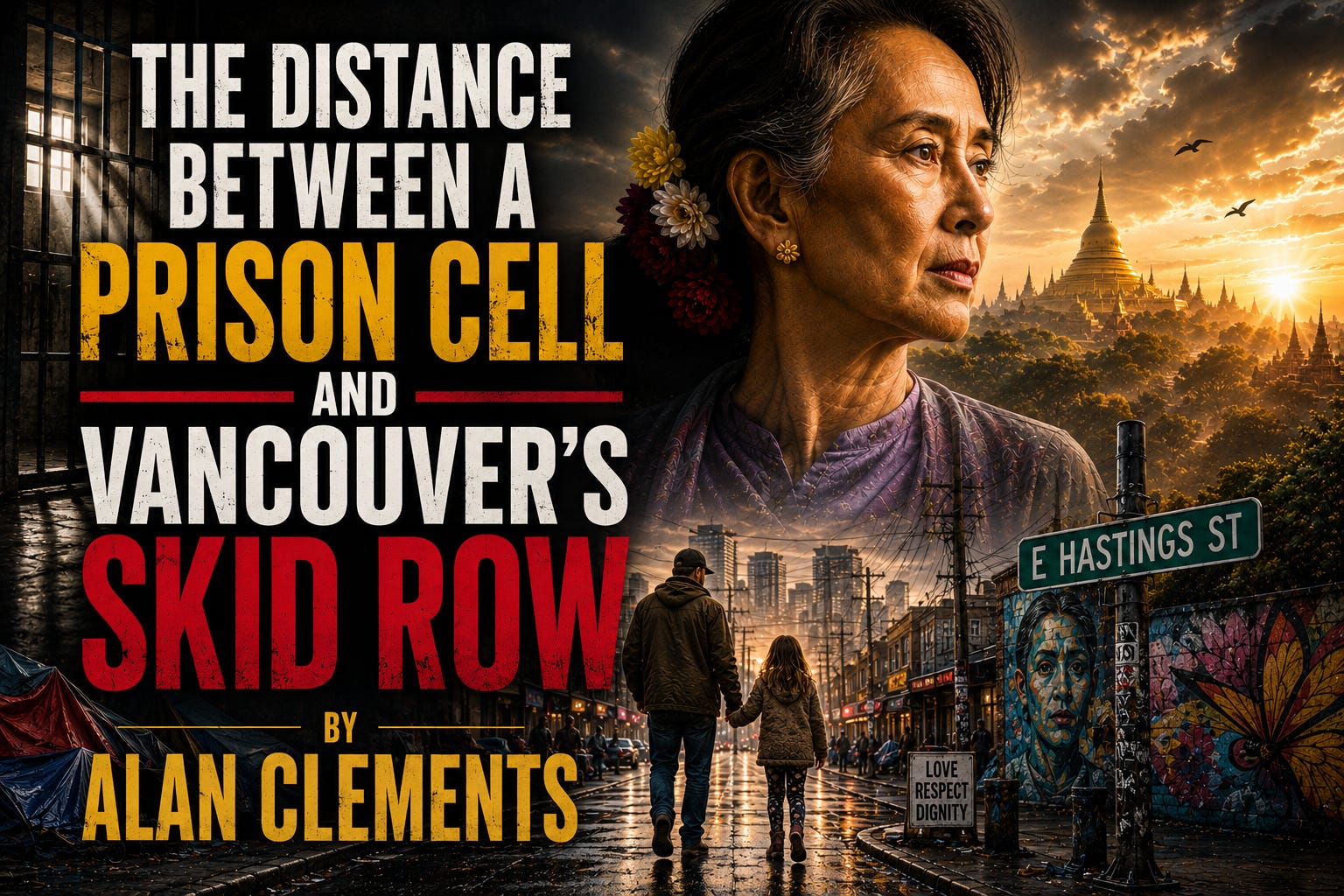
Dear friends,
I’ve just published a new essay, The Distance Between a Prison Cell and Vancouver’s Skid Row, inspired by a recent walk along East Hastings in Vancouver, a neighborhood marked by extreme poverty, widespread homelessness, and the devastating realities of a toxic drug crisis rarely witnessed at this scale in a city of such beauty and wealth. Yet beneath the labels, the statistics, the diagnoses, and the often-disturbing images are human beings—each carrying a life, a history, a wound, a longing, and a story we can never fully know.
Walking there unexpectedly brought back memories of East Hastings’ strange entanglement with Burma and dictatorship, political imprisonment, my beloved daughter, and encounters with suffering across very different worlds. What began as a walk through one of Vancouver’s most troubled neighborhoods became something more intimate: a meditation on love, vulnerability, and the strange threads of human experience that connect lives and places that, on the surface, appear to have almost nothing in common.
More than anything, the essay is a reflection on what it might mean to live with an undefended heart—to remain open, curious, vulnerable, and fully human without pretending that we possess all the answers. Increasingly, this is what love means to me: something humble and pure, less about possession or certainty than about the willingness to remain open to the mystery of another person; to love without armor, to listen without needing to be right, and to allow tenderness, truth, sorrow, and vulnerability to coexist without diminishing one another.
If the essay moves you, please consider sharing it and subscribing to my weekly writings, which I offer freely. And for those who wish to help sustain this work, there is also an opportunity to contribute.
From my heart to yours,
Alan Clements
The Distance Between a Prison Cell and Vancouver’s Skid Row
A very personal dive by an author and former Buddhist monk into his experiences with Nobel Laureate Aung San Suu Kyi and the crises affecting Burma and the West.
The Geography of a Life
I came to Vancouver as the final stop on an American book tour for The Voice of Hope: Conversations with Aung San Suu Kyi, first published in France in 1996 and subsequently published in the United States by Seven Stories Press in 1997. I had been traveling with a book about Burma and about a woman who had become, almost against her own wishes, an international emblem of political courage. I could not have known then that Vancouver would become the place where some of the most apparently unrelated strands of my life would eventually meet: dictatorship and democracy, narcotics and political power, fatherhood and poverty, war and addiction, spiritual practice and the almost unbearable question of what it means to remain human in the presence of suffering.
Aung San Suu Kyi is imprisoned again. She has been imprisoned so many times, and for such prolonged periods, that the fact itself can begin to sound like an item in the historical record rather than the ongoing confinement of a particular woman. Yet I cannot make that abstraction work for myself. I know her. I knew her family, and I knew her husband, Michael Aris, very well. I knew many of the people who worked with her. Some of the teachers who shaped her life also shaped mine. My relationship with her was never simply that of an author interviewing a political figure, nor was Burma ever merely a country about which I had decided to become informed. I lived there, studied there, loved people there, and spent enough years moving through the country’s political and ethnic landscapes to understand that a dictatorship is not merely an arrangement between a government and an anonymous population. It infiltrates the intimate architecture of life. It enters marriages and bedrooms and classrooms. It enters the nervous system of children. It determines who can speak, who can travel, who can work, who can love openly, and who can disappear.
That is why the present uncertainty about Suu Kyi affects me so deeply. We know remarkably little about her actual condition. There have been reports, photographs and accounts of access by the International Committee of the Red Cross, whose work with political prisoners necessarily depends upon confidentiality and the protection of its access. I understand the logic of that secrecy, but there remains something almost grotesque about the fact that the world must rely on discreet humanitarian channels to establish whether an elderly political prisoner is alive, healthy, adequately treated, or mentally intact while she is held by people whose exercise of power has been marked by systematic brutality. A human life becomes a matter of diplomatic discretion, while uncertainty itself acquires the texture of another cell.
A Daughter on East Hastings
When I first arrived in Vancouver, I lived near East Hastings Street. The neighborhood has since become one of the most recognizable symbols of urban poverty and addiction in North America, although the familiarity of its image may have made it more difficult, rather than easier, to see the human reality contained within it. East Hastings is often discussed in the language of crisis: the overdose crisis, the homelessness crisis, the mental-health crisis, the crime crisis. All of those descriptions contain truths, but there is a danger in the accumulation of such language. A person can disappear beneath the nouns we use to describe the circumstances of his life. “Addict,” “homeless,” “mentally ill,” “sex worker,” “criminal” and “drug user” are useful categories for institutions, but they can become morally anesthetizing when they are allowed to replace the person.
I have another reason for resisting that kind of distance. My daughter grew up inside that geography. After her mother and I separated, my daughter lived with her mother in a halfway house she co-created on East Hastings Street. It was a small, intimate refuge for a carefully selected group of women who had survived abuse, prostitution, addiction, poverty, or some combination of circumstances that had pushed them outside the ordinary protections of society. For the first ten, eleven, perhaps twelve years of my daughter’s life, I would go down to East Hastings to pick her up. We would leave the neighborhood together and go somewhere that, to her, was simply the rest of the world: a park, a playground, a movie theatre, my home, somewhere to eat. Those excursions were not political acts. They were the ordinary rituals of a father and daughter trying to make a life together, but because of where they began, East Hastings became part of the geography of my fatherhood.
That is one of the strange things about cities. They contain the whole of a person’s life without announcing it. A street corner that one person experiences as an urban emergency may be the place where another person’s child learned to ride a bicycle, where somebody fell in love, where somebody died, where somebody waited for a father to arrive. A neighborhood acquires a public reputation, but the private histories embedded inside it remain invisible.
A few days ago, I walked the length of East Hastings again, perhaps for the last time. I walked slowly, without a camera and without the intention of turning the people I encountered into evidence for an argument I had already decided to make. I did not want to look voyeuristically. I wanted to experience the street, if that is possible, through something other than the familiar vocabulary of reportage. I wanted, for once, to notice what the street was doing to me before deciding what I might later say about it.
Bodies in Suspension
What I felt was difficult to contain. There were dozens of people, some in wheelchairs bent forward almost at right angles, others standing or sitting in postures that seemed to have been interrupted halfway through a movement, still others gathered in small groups in states of apparent suspension. There were three or four people together, then five or seven, sometimes more, and for a moment the arrangement of their bodies had the strange visual quality of an experimental theatre piece. But there was no performance. The contortions were not symbolic. The people were not actors. They were human beings whose consciousness and motor systems had been overwhelmed, temporarily or permanently, by a substance whose name has become one of the defining words of contemporary North American life: fentanyl. A synthetic opioid as much as one hundred times more potent than morphine, fentanyl can suppress breathing with extraordinary speed and has become the dominant lethal presence in British Columbia’s unregulated drug supply. The scale of the devastation is difficult to comprehend. Vancouver’s Downtown Eastside has suffered a toxic-drug death rate roughly ten times the provincial average, while across British Columbia 1,826 people died from unregulated drug toxicity in 2025 alone—an average of five human beings every day. Yet even those numbers seem to me somehow inadequate. Statistics can measure the dead; they cannot tell us what it means to stand on a street among the living and watch a human being become, however temporarily, almost unreachable inside his or her own body.
I know very little about the chemistry, and I do not want to manufacture expertise where I have none. I know, however, what it looks like when a human being’s relationship to consciousness is violently altered. What struck me was not only the possibility of death, terrible as that is. It was the sight of people who were still alive but seemed, for periods of time, scarcely able to inhabit their own lives. Their bodies remained in the world while some essential relationship between intention, consciousness and movement had become terribly unstable.
The word fentanyl has become so common that it can almost pass through the mind without leaving an impression. We hear it in political speeches and public-health announcements, in newspaper headlines and conversations about crime, in the language of statistics and municipal policy. But statistics have a peculiar relationship to the human imagination. They allow us to know that something enormous is happening while protecting us from actually experiencing its enormity. A number can tell us how many people have died. It cannot tell us what it is for a human life to become nearly unrecognizable from within itself.
Standing there, amid that terrible suspension of bodies and intention, I found myself thinking about Burma.
The Narcotics Road Between Burma and Vancouver
For much of my adult life, I have been preoccupied with the relationship between political power, narcotics and war. I spent years traveling through Burma and along its borders, including areas associated with the Golden Triangle. I saw laboratories and trafficking routes. I encountered dealers, armed groups and people whose livelihoods had become entangled with an economy that was simultaneously criminal, political and profoundly profitable. The narcotics trade was never simply a matter of drugs moving from one place to another. In the regions I knew, it was embedded in the political economy of conflict, corruption and military power.
The heroin produced in and around the Golden Triangle did not remain in the mountains of Southeast Asia. It moved through international networks and eventually appeared in cities thousands of miles away, including Vancouver. I remember being struck by the almost obscene elegance of the connection. A political system on the other side of the world could generate an economy whose consequences eventually arrived on a street in a Canadian democracy. The dictatorship did not need to export soldiers to Vancouver. The economies surrounding its wars could cross oceans more efficiently than armies.
At the time, I became increasingly vocal about this connection in interviews and public appearances. It seemed to me that the conventional division between foreign policy and domestic social policy was often artificial. We liked to think of political violence as something that happened “over there” and addiction as something that happened “here,” as though the two existed in sealed compartments. But the world does not work that way. Money crosses borders. Chemicals cross borders. Weapons cross borders. Refugees cross borders. Trauma crosses borders. History itself crosses borders, frequently disguised as commerce. The consequences of political decisions made in one part of the world can eventually become visible in the body of a person living in another.
The contemporary fentanyl economy is not simply a continuation of the heroin economy, and it would be intellectually careless to pretend otherwise. Synthetic opioids have transformed the scale, speed and structure of the drug trade, while precursor chemicals, manufacturing, trafficking and criminal organizations operate across an extraordinarily complicated international network. China, Myanmar and other countries appear at different points in various supply chains, but the precise routes shift, and simplistic geopolitical narratives rarely survive contact with the facts. What does endure, however, is the deeper question that has haunted me for decades: what does it say about a civilization when substances capable of extinguishing consciousness can become the basis of an immensely profitable transnational economy?
That question becomes even more disturbing when considered alongside the political conditions in which some of these economies flourish.
The Children and the Songs
Myanmar has endured decades of military rule, civil war, ethnic persecution and displacement. The current conflict has produced an enormous humanitarian catastrophe. I was recently near the Thai-Burmese border and briefly inside an internally displaced persons’ camp. What I encountered there was almost impossible to reconcile with the ordinary rhythms of life elsewhere. People had been uprooted from homes and villages, exposed to violence and forced into a condition of permanent uncertainty. I was told by a psychiatrist about thirteen-year-old girls who, after experiences of severe trauma, had taken their own lives.
I carried those children with me as I walked East Hastings. The juxtaposition was almost unbearable. On one side of the world, a thirteen-year-old girl is traumatized by war to the point that she can no longer imagine a tolerable future. On another side, adults sit or stand in a state of chemical paralysis on a street in a prosperous Canadian city. The circumstances are radically different, and any attempt to collapse them into a single story would be intellectually dishonest. Yet something in the nervous system of the human species connects them. In both cases, a human being has become overwhelmed by forces larger than the individual.
And yet, in the camps along the Burmese border, I also encountered something that has become increasingly important to me: people singing. They sang in circumstances in which singing seemed almost irrational. They sang after losing homes, after witnessing violence, after being displaced and frightened. There was laughter, too, and friendship, flirtation, humor, food, music, the small rituals through which human beings insist upon remaining human. The capacity for joy had not been abolished by suffering. It seemed at moments almost incandescent precisely because suffering had made the fragility of life impossible to ignore.
That paradox has stayed with me. We are capable of suffering beyond what we imagine we can endure, but we are also capable of producing beauty under circumstances in which beauty appears almost impossible. These are not opposite truths. Mysteriously, they belong to the same creature.
Perhaps this is what I was responding to on East Hastings. I was not simply horrified by what I saw. I was overwhelmed by the unresolved mystery of it. I kept looking at people and wondering about the lives that had preceded the bodies in front of me. Who had they been before the street? Who had loved them? Had they once been somebody’s brilliant little girl, somebody’s mischievous son, somebody’s husband, somebody’s mother? What had happened between that earlier person and the person now bent forward under the influence of a drug?
The question “What is wrong with you?” seemed suddenly inadequate. A more human—and more difficult—question was: “What happened to you?” That question does not absolve anyone of responsibility. It does something more demanding: it restores complexity. A person can be responsible for his actions and still have been profoundly wounded. A person can have harmed others and still deserve to be treated as a human being. A society can recognize the necessity of public safety while refusing to abandon the people whose lives have become dangerous to themselves and others. Compassion does not require sentimentality, just as accountability does not require dehumanization.
I find myself increasingly wary of explanations that are too complete. I have lived long enough to know that addiction cannot be explained solely by personal weakness, nor solely by trauma, poverty, mental illness, criminality, pharmaceutical corporations or international trafficking. It exists in the unstable territory where these forces converge. Causes interact; consequences become causes in their turn. Institutions inherit problems created by other institutions, families inherit wounds they did not create, and children inherit histories they did not choose.
Political violence is like this. Poverty is like this. So, too, is the intimate life of a human being. We like clean categories because they make action possible. But reality is rarely clean. A person can be victim and perpetrator, privileged and wounded, loving and destructive, courageous and afraid. A nation can be democratic and deeply unjust. A political movement can liberate one group while failing another. A spiritual teaching can become an instrument of liberation in one person’s hands and an instrument of denial in another’s. Reality owes nothing to the categories by which we attempt to make it manageable.
The Limits of Understanding
Walking through East Hastings, I felt the limits of my own categories, and with them the limits of my power. I could not solve what I was seeing. I could not restore someone’s childhood. I could not reverse an addiction through the force of my compassion. I could not dismantle the global narcotics economy by writing another essay. I could not end the war in Myanmar, free every political prisoner, or guarantee that the next generation of children would inherit a world less violent than the one we have given them. The helplessness was almost physical.
I found myself crying without quite crying, weeping somewhere beneath the visible surface of the body. It was not a theatrical response. It was closer to the body’s recognition of something the mind could not resolve. I was grieving for the people on the street, for the people in the camps, for the imprisoned, for the children, and, strangely enough, for myself and the peculiar arrogance hidden inside the hope that if I understood suffering deeply enough, I might eventually learn how to fix it.
Perhaps understanding does not always culminate in fixing. Sometimes it asks something quieter and more difficult of us: that we remain present.
This is where my Buddhist training returns to me, though I have become increasingly suspicious of spiritual language that attempts to make suffering beautiful. Suffering is not necessarily a lesson. Trauma is not necessarily a gift. A thirteen-year-old girl who has been driven to suicide by war does not need her suffering converted into a parable about spiritual growth. Someone dying of an overdose does not need to be told that everything happens for a reason. There are forms of spiritual consolation that become another way of refusing to look directly at what has happened.
What contemplative practice has taught me, at its best, is something more modest: the discipline of remaining present without immediately imposing a story on what I see. It has taught me that I can look at suffering without requiring it to become meaningful; that I can acknowledge what I do not know; that grief need not be converted into doctrine before I am willing to feel it. Perhaps from that more undefended position, action becomes more honest.
We need better drug policy. We need treatment that is accessible and humane. We need mental-health care that does not require people to reach the point of catastrophe before they qualify for assistance. We need housing. We need public-health systems capable of responding to a crisis of this magnitude. We need law enforcement that can protect communities without turning vulnerable people into enemies. We need international cooperation capable of confronting precursor supply chains, trafficking networks and the political economies that make narcotics so profitable. We need to understand why certain communities are so vulnerable to addiction in the first place, and we need to stop pretending that a wealthy society can tolerate large populations of profoundly traumatized people living on its streets without eventually paying an enormous moral and social price.
Yet even such measures become insufficient the moment we lose sight of the person, because the person is where abstraction ends, where policy becomes flesh and where politics finally becomes ethics.
The Prisons We Carry
This is also where love becomes more demanding than the sentimental version of love that is so easy to invoke. To love another human being is not merely to feel tenderness toward them. It is to permit their existence to complicate your own. It is to listen when listening is inconvenient, to remain curious when judgment would be easier, to tell the truth without humiliating, to forgive without pretending that nothing happened, and to accept that another person cannot be possessed simply because we love them.
I have learned this in politics, in Buddhism, in friendship, in fatherhood and, perhaps most painfully, in intimate love. We are constantly tempted to turn people into roles: the prisoner, the activist, the father, the lover, the addict, the refugee, the saint, the villain. A role simplifies what a life refuses to simplify. A person is always more than the identity we assign.
That may be one of the reasons I have remained so attached to the idea of liberation. Political freedom matters because a human being should not be imprisoned by a government for thinking, speaking or organizing. But there are other forms of imprisonment that require a different vocabulary. Addiction can imprison. Trauma can imprison. Hatred can imprison. Fear can imprison. The inability to forgive can imprison. Even our most cherished identities can become prisons when we mistake them for the totality of who we are. The deeper challenge may be to discover forms of freedom spacious enough to include our interdependence rather than escape from it.
I have spent much of my life thinking about the Burmese struggle for democracy, and I still believe profoundly in the necessity of political freedom. But I am less interested now in the mythology of heroes than I once was. Aung San Suu Kyi matters to me because she is a human being who made extraordinary sacrifices, not because she can be placed on a pedestal and relieved of her humanity. The people of Myanmar matter because they are people, not because their suffering can be recruited into someone else’s political narrative. The people on East Hastings matter for precisely the same reason.
There is a danger in turning suffering into symbolism. The moment we make a person entirely emblematic, we risk relieving ourselves of the obligation to encounter the irreducible person underneath the emblem. Perhaps this is why the walk affected me so profoundly. East Hastings stripped away abstraction. There was no “opioid crisis” in front of me. There were bodies. There were faces. There were people whose consciousness was flickering in and out of reach, people whose lives had become almost impossible to imagine from the outside.
And there was me, walking among them with the unfinished archive of my own life trailing behind me: my daughter and Burma, Aung San Suu Kyi and the Golden Triangle, refugee camps and thirteen-year-old girls, songs and prisons, drugs and streets—the strange continuity of suffering across the distances by which we imagine ourselves protected.
A Single Tangled Field
I realized that I have spent much of my life trying to connect things that other people prefer to keep separate. Burma and Vancouver. Dictatorship and addiction. Political economy and private despair. Meditation and activism. Fatherhood and social responsibility. Love and liberation. Perhaps that has been my particular obsession, and perhaps it is why the world continues to appear to me as a single, tangled field rather than a collection of separate problems.
The boundaries are real, but they are porous. What happens in one place eventually touches another; what happens to one person enters the lives of others. A war creates refugees. A refugee carries trauma. Trauma enters a family. A family enters a city. A city develops a crisis. A crisis generates politics. Politics generates narratives. Narratives generate blame. Blame generates more distance. And somewhere inside the whole process, a human being sits alone and wonders whether anyone can still see him.
The opposite movement is possible, too. Someone sings. Someone listens. Someone offers shelter. Someone takes a stranger to a clinic. Someone refuses to participate in cruelty. Someone writes a book. Someone walks into a prison. Someone crosses a border. Someone falls in love and, for a while, makes another person’s existence feel less lonely. These acts may not change history in the way that history books record it, but they alter the interior history of human beings, and perhaps every larger history is finally composed there.
After I finished walking, I went home. I meditated for a while and took a hot bath, trying to let my nervous system return to something resembling equilibrium. I felt the grief receding, though not disappearing, and underneath it there was something quieter. I thought about how astonishing it is that, despite everything we do to one another and everything we do to ourselves, beauty keeps appearing.
It appears in Myanmar, where people who have lost almost everything still sing; in Vancouver, where people continue to care for one another despite the exhaustion of a crisis that seems to have no end; in friendship and fatherhood; in lovers still willing to risk vulnerability; in strangers who perform small acts of kindness without expecting to be noticed. It appears, most mysteriously, in the fact that consciousness, despite all the reasons it has to close, can still open.
I don’t know what the final answer is. I no longer believe there is one sentence, one political program, one spiritual insight, or one act of will that can redeem the human predicament. The world is too intricate for that, and we are too contradictory. We are capable of extraordinary tenderness and extraordinary cruelty, sometimes within the same hour, sometimes within the same person.
What I do know is that I do not want to become numb: not to the suffering of strangers until it becomes urban scenery, not to the imprisonment of a friend until it becomes merely another item in the news, not to fentanyl deaths until they become statistics, not to the children of Myanmar until they become casualties inside somebody else’s geopolitical narrative. Nor do I want my own failures in love, friendship or fatherhood to become excuses for withdrawing from the lifelong attempt to love more intelligently.
The Work That Remains
Perhaps, at this stage of my life, that is the work that remains: not “awakening” in the romantic sense of perpetual enlightenment, but the harder practice of refusing to let familiarity become indifference. To remain capable of being shocked by what should shock us, moved by what should move us, and grateful for what remains beautiful even when beauty is surrounded by catastrophe.
I think of Aung San Suu Kyi somewhere in isolation, though I do not know exactly where or under what conditions. I think of my daughter as a little girl waiting for me on East Hastings, and I think of the man I am now walking the same street decades later. I think of the people in Myanmar singing after losing almost everything. I think of the people on the Vancouver pavement whose bodies have been temporarily colonized by a chemical whose production and distribution are part of a global system none of us fully sees.
I think of how impossibly far apart these lives appear, and how intimately connected they are. The distance between a prison cell in Myanmar and a street corner in Vancouver is thousands of miles. The distance between one human being and another, measured by our capacity to suffer with and for each other, can collapse in an instant.
That is the paradox I am left with. We are separate enough to wound one another, imprison one another, abandon one another and forget one another. Yet we are also connected enough that the suffering of a stranger can enter the body of someone walking down a street nearly two decades after he once came there to collect his young daughter, and can cause him, without warning, to stop and feel the entire bewildering weight of being alive.
I don’t know whether this is wisdom or merely experience. Perhaps it is both. What I know is that after all these years—after Burma and Vancouver, political imprisonment and addiction, camps and streets, books and friendships and failures—I still believe in the possibility of an undefended heart. Not because the world deserves our optimism, and not because suffering has some hidden purpose that we are obliged to discover, but because closing the heart does not make suffering disappear. It only guarantees that suffering will have one witness fewer.
So I will try, for whatever time remains to me, to keep witnessing. I will try to remain present with the person in front of me, whether that person is a political prisoner, a refugee, a stranger on East Hastings, a friend, a daughter, a lover, or simply someone whose life has intersected with mine for an hour or for fifty years. I will try to resist the seduction of certainty and the comfort of distance, and I will try to remember that every human being I encounter is carrying an interior world I cannot fully know.
Perhaps compassion begins precisely there: not in the confidence that we understand another human being, but in the humility of knowing that we do not. And perhaps mature love is less the achievement of understanding than the decision to remain interested in the mystery.
Before Reality Can Be Changed
I walked home from East Hastings with no solution in my pocket. I had not rescued anyone, changed a policy, ended a war, freed a prisoner, or healed a wound. I had only walked, watched, remembered and allowed myself to be affected. Yet I have come to think that being affected may be the beginning of responsibility. Before reality can be changed, it must first be permitted to become real to us.
Too many people disappear because their suffering has become familiar, and I do not want to become one more person who learns how to walk past. And so, from this strange place in my life, I find myself grateful—not for the suffering, because I will never romanticize that, but for the capacity to feel it. I am grateful for the people who have broken my heart open. I am grateful for my daughter, for Burma, for my teachers, for my friends, for the people who have loved me despite my failures, and for the strangers whose lives I will never know but whose existence has nevertheless altered me.
If we meet somewhere along the remaining road, I hope I will recognize something in you that is larger than whatever category the world has placed you inside. I hope I will remember that you, like me, are unfinished, vulnerable, contradictory and temporary, and that whatever we are given to do with our brief passage through this astonishing existence, surely it asks more of us than merely surviving it.
It asks that we remain human inside it—and perhaps, after everything I have seen, that remains the most radical thing I know how to ask of myself.
Alan Clements is an American author, former Buddhist monk, human-rights advocate and longtime writer on Burma/Myanmar, democracy, political imprisonment and the moral questions raised by power and violence. He is the author of seventeen books, including The Voice of Hope: Conversations with Aung San Suu Kyi, the groundbreaking volume of conversations with the Nobel Peace laureate that brought Clements into close personal and intellectual engagement with one of the defining political figures of modern Asia. His work has taken him repeatedly into the worlds of political dissidence, Buddhist practice, exile, war, narcotics and humanitarian crisis, giving his writing an unusual vantage point at the intersection of political history and intimate human experience.
Clements lived and worked in Burma during the years of military dictatorship and has spent decades documenting the country’s struggle for democracy and the experiences of its political prisoners, ethnic minorities, refugees and dissidents. His reporting and advocacy have brought him from the corridors of international politics to remote borderlands and refugee communities, while his writing has consistently sought to connect the abstractions of geopolitics with the lived experience of individual human beings. He has written extensively about the relationship between authoritarian power, the narcotics economy and the international systems through which violence and its consequences travel.
His work is informed as much by decades of Buddhist practice as by political activism. That combination—of political engagement and contemplative inquiry—has shaped a body of writing concerned not only with freedom from external oppression, but with the more intimate questions of consciousness, suffering, responsibility, compassion and human liberation. His books and essays have sought to resist the easy separation of the political from the personal, asking how the great forces of history eventually enter the lives, bodies and relationships of ordinary people.
Clements continues to write and speak about Myanmar, democracy, human freedom, Buddhism and the enduring possibility of compassion in an increasingly fractured world. His work is ultimately animated by a conviction that political freedom and inner freedom, however different their forms, belong to the same unfinished human project: the struggle to remain fully human in a world that continually gives us reasons to become otherwise. See more of his work on his website: www.AlanClements.com
In my grief about what is happening in the world, Alan, your words bring the solace of knowing that someone - you - also bears witness and feels “the entire bewildering weight of being alive.” A small synchronicity: yesterday I offered up a word to someone I was mentoring, describing her relationship with the world and I offered the word: undefended? Yes a heart undefended. Then I read this today, a deep and beautiful description of what it means to be an undefended heart in this aching and beautiful world. It seems such a small contribution at times, but I agree with you: I am glad that I am not numb, that I refuse to be numb, that I feel the world deeply. I also trust that from deep feelings from an undefended heart can come true action. But it begins with feeling.
Thanks for your ongoingness of showing up, over decades…Your words always help me.
Big hug ❤️